Saturday, March 21, 2015

Refined Prototypes. Round Two

Solar Jar: 

This is a rough version of the solar prototype. I still need to find a suitable solar light but they general idea of this annotation is: Message in a Bottle.

The exterior message contains information on how one can incorporate solar energy into residential living.  The interior message contains information on how to make a solar energy jar. There will be vector drawings illustrating what is needed to produce said jars.


For refinements I would like to create a simple vector drawing of a house. Certain elements of the house will demonstrate how to be more aware of the environment.


Solar FanThis is a very rough prototype as well, but one can understand the general idea.


Pinwheel

Pinwheel design that is more advanced. The main problem currently is readability, and not throwing too much information at the viewers.


Friday, March 20, 2015

TM Research


Issue Listings:
1978 Issue 1-6.
Gregory Vines: Gregory Vines was an American graphic designer, who initially began his studies in the United Stated but later attended Schule fur Gestaltung Basel.Reflection: These designs are primarily employ: photography, typography, and illustration. Vines is similar to Siegfried Odermatt in his design layout. For instance, each issue has the same arch, which appears to crop photographs. When the photograph is cropped, Vines illustrates mathematical graphs or diagrams on each photograph. This blending of illustration and photography creates a beautiful abstract design for viewers, which makes one question what they are seeing.As a child, my siblings and I would watch a show called COMBAT! starring Vic Morrow. Morrow was a sergeant of a WWII squad and they would travel the terrain of France of reconnaissance missions. Gregory Vines images remind me of maps that appeared on that show, as well as the European scenery. I believe this is why I was drawn to this series of images, everything seems so calculated and well planned. It is as if there is a secret meaning behind each design and the viewer must crack the code. 


Friday, March 13, 2015

Brainstorming Diargrams

This 5x5 Grid was helpful to both aspects of the project. Initially, I did not fully understand its purpose, but I often found myself returning to this grid when I felt I was drifting from the overall purpose of the project. I will most assuredly being using these in the future for projects.


Monday, March 9, 2015

Process Post #8

Spatial Photographs:


Spatial Drawings:

Print Photographs:


Print Document:


Persuasive Advertising:


Wednesday, March 4, 2015

Poster+ Prototypes

Here are my initial prototypes for an accompanying annotation for the poster.

My first prototype exploration involves an actual display of how solar energy works. I would create a homemade solar lamp jar, which consists of a glass jar (decorated/undecorated) and a component of a solar yard lamp. The solar yard lamp would replace the lid of the jar, therefore creating an eco-friendly lantern.


To accompany this visual display, I would create a small book. This book would resemble a solar panel, but more importantly it would contain information on how the community can move forward by embracing solar energy in their everyday environments.


My second prototype is based on the idea that: "The energy that drives wind originates with sun, which heats the earth," (National Geographic) therefore providing solar energy. So I decided to have pinwheels be an interactive and friendly reminder/encourager for the community members. The pinwheels would have typography relevant to how to move forward with implementing solar energy into one's everyday life, with some friendly icons to accompany this text.

The more important message that this pinwheel contains is making the audience think of their children and future generations to come. Specifically how converting to solar energy can only benefit their lives. The viewers would be able to take the pinwheel home to place near the front walkway, reminding them and encouraging to help the environment by converting to solar energy.


My third prototype is more visual, but it will be accompanied by a phone app. The phone app will have information on solar energy technologies and ways to add them to your daily environment.


Tuesday, March 3, 2015

Poster+ Solar Energy Research

This is the poster that I was assigned:

This was the information I retrieved on the Solar Energy Process:


Solar energy technologies use the sun's energy and light to provide heat, light, hot water, electricity, and even cooling, for homes, businesses, and industry. There are a variety of technologies that have been developed to take advantage of solar energy:
Photovoltaic Systems: Producing electricity directly from sunlight.

·         Possible Solar Cell Devices:
o   Rooftop shingles, roof tiles, building facades, or the glazing for skylines.

Solar Hot Water: Heating water with solar energy.

·        Solar Water Heating Systems:
o   Solar collector and a storage tank.

·        Active or Passive Systems?
o   Active systems rely on pumps to move the liquid between the collector and the storage tank, while passive systems rely on gravity and the tendency for water to naturally circulate as it is heated.

Solar Electricity: Using the sun's heat to produce electricity.

·        Three main types:
o   Parabolic-trough: long rectangular curved mirrors absorb sun’s energy.
o   Dish/engine: energy gathered by dish to create mechanical power to run a generator.
o   Power tower: large field mirrors concentrate sunlight onto tower, which heats molten salt through the receiver. The heat of the salt is the generator for electricity; but more importantly, molten salt can maintain its heat for a long period of time. This allows electricity to be run on cloudy days and even after sunset.
Passive Solar Heating and Daylighting: Using solar energy to heat and light buildings.
·         Direct Gain: Floors and walls collect heat during the day, then the retained heat is slowly release at night when it is needed most.
o   Sun spaces, trombe walls, and clerestory are all techniques for maintaining energy.
Solar Process Space Heating and Cooling: Industrial and commercial uses of the sun's heat.
·        Types of Systems:
o   Transpired collector: consists of a thin, black metal panel mounted on a south-facing wall to absorb the sun's heat. Air passes through the many small holes in the panel. A space behind the perforated wall allows the air streams from the holes to mix together. The heated air is then sucked out from the top of the space into the ventilation system.
o   Evacuated-tube collector: a shallow box full of many glass, double-walled tubes and reflectors to heat the fluid inside the tubes. A vacuum between the two walls insulates the inner tube, holding in the heat.
o   Parabolic-trough collector: long, rectangular, curved (U-shaped) mirrors tilted to focus sunlight on a tube, which runs down the center of the trough. This heats the fluid within the tube.

Monday, March 2, 2015

Process Post #7


 These were my initial sketches for three possible book designs:

This idea is intended to be similar to a brochure, except in a different layout format. This format is unique and permits the user to interact with this small pamphlet while they tour the interior space.


This is a simple book layout that would be composed of 18 pages, documenting Parker's life through stages. The book would be square shaped, easily fitting into one's hand or purse.


This idea would be the most interactive experience. Viewers would receive an envelope, which contain several postcards documenting Parker's life in stages. The only problem with this solution is possible organization, making sure the viewer receives everything in the proper order. 

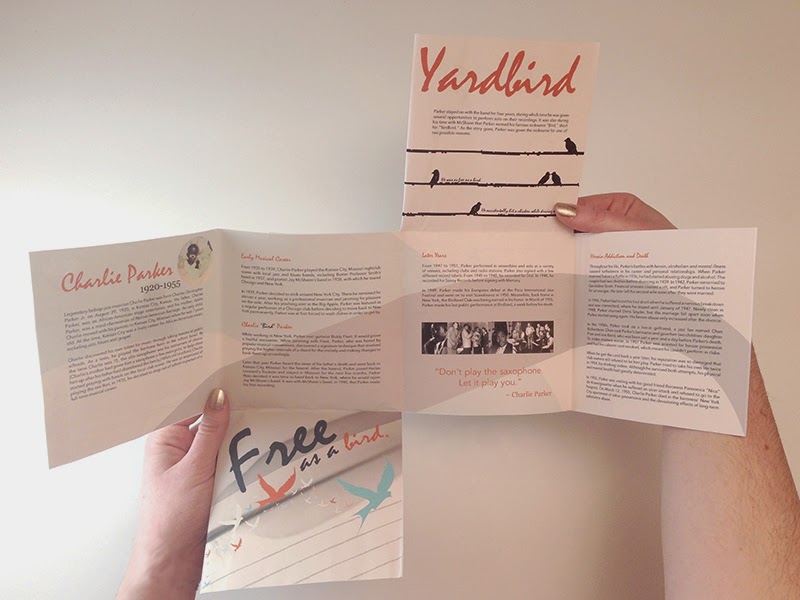
In the end, I decided to pursue my first idea: the brochure. Here is the result.


I admire this design the best because I was able to incorporate several aspects of the interior space, but in a a completely different way. Giving the viewers a more practical experience.

I also accomplished the elevations of the interior space:


Interior and exterior spacing, flat layout.